
Burstow
Primary School

British Values
British Values
At Burstow Primary, we recognise the importance of preparing children for life in modern Britain and promoting values that are an integral part of 21st century British society.
In accordance with The Department for Education, we aim to actively promote British values in our school to ensure young people leave school prepared for life in modern Britain. Pupils are encouraged to regard people of all faiths, races and cultures with respect and tolerance and understand that while different people may hold different views about what is ‘right’ and ‘wrong’, all people living in England are subject to its law.
The Key British Values are:
-
democracy
-
rule of law
-
individual liberty
-
mutual respect
-
tolerance of those of different faiths and beliefs
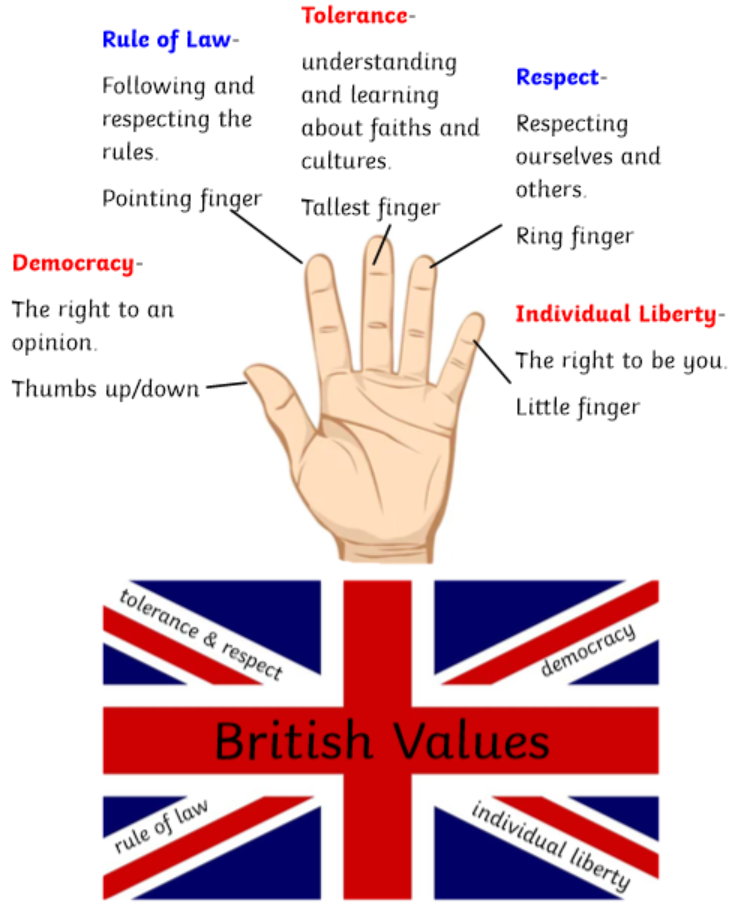
We help children remember the British Values through the thumb and finger model
Thumb – Democracy – up or down to give opinion.
Index Finger – Rule of Law – pointing
Middle Finger – Tolerance of different faiths and beliefs – tallest finger pointing to sky
Ring Finger – Mutual respect – wedding ring – respect for other people
Little Finger – Individual Liberty – sticks out on its own.
Democracy
Children vote for Pupil Parliament members.
Democracy linked assemblies e.g. Parliament Assemblies with a strong focus on pupil voice.
Pupil feedback is sought during Class Forum, assembly and class time, through questioning and conferencing and a pupil survey about their education at Burstow Primary is conducted on an annual basis.
Rule of the Law
Values-based education
Assemblies on kindness.
Assemblies linked to the law: school rules, value of respect.
Pupil voice: Parliament assemblies and Pupil Focus Groups
Parents/carers – Surveys relating to behaviour and safety
School behaviour / Restorative justice: Children are helped to understand their behaviours and consequences. During restorative conversations, adults spend time discussing better ways of managing feelings.
Visits from police officers
Curriculum: People who help us
Restorative practice.
Speaking and listening curriculum: Giving opinions and explaining reasons; debating.
Use these questioning skills across the curriculum to elicit children’s opinions and reasoning. Dialogic teaching – pupils respectfully respond to each other’s ideas using modelled sentence starters.
RE and PSHE lessons, we provide opportunities to debate and discuss the reasons for laws so children can recognise the importance of these for their own protection and progression and for other’s also.
Tolerance of culture, faith and orders
RE curriculum.
Equalities Policy.
Behaviour Policy.
Cultural themed assemblies e.g.
Diwali, Chinese New Year etc.
Mutual Respect
Anti-bullying week.
Anti-Racist curriculum.
Shared, common ethical vocabulary reinforced daily – Respect is one of our school values.
Positive relationships encouraged, taught and modelled – pupil to pupil, adult to pupils and adult to adult.
Ealing RE and PSCHE curriculum
Pupil Focus Group and Parliament Assemblies – pupil voice valued.
Peer reading buddies.
Talking Partners in every classroom changed regularly.
Individual Liberty
Creating a positive culture and ethos in our school; as such children learn in a safe environment where choices and freedoms are encouraged.
We provide opportunities for children to choose their learning tasks and to select the task that will challenge them the most, giving them more freedom and independence to determine their own learning. These are known as the challenges
A range of clubs which pupils have the freedom to choose, based on their interests.
Through our Online Safety and PSHE sessions, we educate children on their rights and personal freedoms as well as supporting them in recognising how to exercise these freedoms safely.
We believe that valuing choice and freedom in daily school life will foster a value for individual liberty as the children embark upon their adult lives.
Understanding own responsibility in school in terms of behaviour and learning attitudes – Values education .
Pupil’s role within the school community – becoming the best citizen that they can be.
Four values– known and articulated by school community members.
Weekly values assemblies.
Values displayed in every classroom and values lists displayed around the school and evident in action.
Sensory equipment in every classroom for when pupils need to calm down and think about their choices.
Celebration assemblies.